
How Does an MBA for Working Professionals Work? Eligibility, Classes, Fees & Career Benefits (2027)
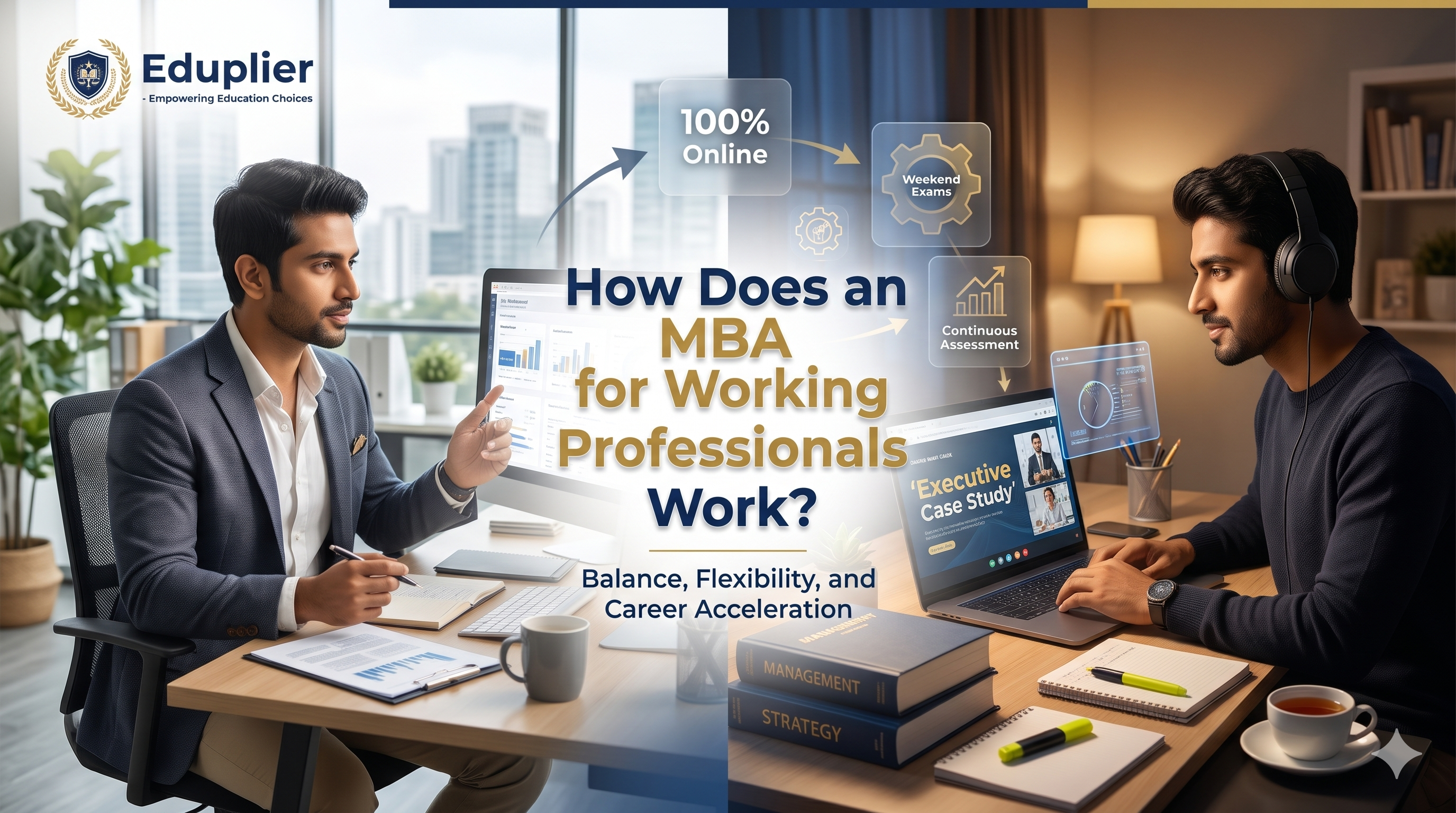
Are you a working professional who wants to pursue an MBA but cannot leave your job? You are not alone. Many employees want to improve their management skills, qualify for better positions and increase their career opportunities without taking a break from their professional responsibilities.
An MBA for Working Professionals provides an opportunity to pursue higher education while continuing to work. With flexible learning options such as online MBA programs, distance MBA programs and executive MBA courses, professionals can choose a study format that suits their career goals and daily schedule.
But how does an MBA for working professionals actually work? Do you need to attend daily classes? How are examinations conducted? Can you complete assignments after office hours?
In this guide, we explain everything about pursuing an MBA while working, including eligibility, learning methods, fees, examinations, benefits and admission procedures.
Yes, you can pursue an MBA while working. Most online MBA programmes in India run for two years in four semesters, with live or recorded classes, assignments and semester exams. Before you enrol, verify the university, the specific programme and your admission session on the UGC-DEB portal, and check how exams are conducted.
1. What Is an MBA for Working Professionals?
An MBA for working professionals is a management education program designed for individuals who want to develop business and management knowledge while continuing their employment.
Unlike a traditional full-time MBA, which generally requires students to attend regular campus classes, flexible MBA options may offer online lectures, recorded sessions, digital study materials, weekend classes or distance learning facilities. These programs help employees manage their education alongside professional and personal responsibilities.
Working professionals from different industries can consider an MBA in specializations such as:
- Marketing Management
- Finance Management
- Human Resource Management
- Business Analytics
- Operations Management
- International Business
- Information Technology Management
- Digital Marketing
The available specializations depend on the university and its approved program structure.
2. How Does an MBA for Working Professionals Work?
An MBA for working professionals generally follows a structured academic system. Students complete subjects, attend learning sessions, participate in academic activities, submit assignments and appear for examinations. The exact learning process depends on whether you choose an online, distance, executive or part-time MBA. Here is how an online MBA generally works.
Step 1: Online Admission Process
The first step is selecting a suitable university and MBA specialization. Students generally need to:
- Check the eligibility criteria.
- Compare university fees and specializations.
- Complete the online application form.
- Upload the required documents.
- Pay the applicable admission fee.
- Complete the university’s verification process.
After successful admission, the university provides access to its learning management system (LMS) or student portal.
Step 2: Online Classes and Recorded Lectures
One of the biggest advantages of an online MBA is learning flexibility. Universities may provide:
- Live interactive classes.
- Recorded video lectures.
- Digital textbooks and study materials.
- Online discussion forums.
- Case studies and practical assignments.
- Faculty interaction and academic support.
Working professionals can attend scheduled sessions when available and use recorded lectures to revise topics according to their schedules.
Step 3: Study According to Your Schedule
Online MBA programs allow students to manage their learning around professional responsibilities, subject to the university’s academic calendar and participation requirements. For example, a working employee can:
- Study for one hour before office.
- Watch recorded lectures after work.
- Complete assignments during weekends.
- Revise subjects before examinations.
This arrangement can make higher education more manageable for people who cannot attend daily campus classes.
Read More: Online MBA Fees in India: Semester-by-Semester Comparison
Step 4: Assignments and Internal Assessments
An MBA is not limited to watching video lectures. Students must complete academic activities to understand management concepts. Depending on the university, assessments may include:
- Online quizzes.
- Subject assignments.
- Case study analysis.
- Presentations.
- Projects.
- Continuous assessments.
These activities help students understand how management concepts apply to real business situations.
Step 5: Semester Examinations
Most online MBA programs follow a semester-based academic structure. Students generally study different management subjects during each semester and appear for examinations according to the university’s examination schedule.
Examination arrangements depend on the university’s approved program structure and applicable regulations. These may include online proctored examinations or designated examination centres. Students should check examination requirements before taking admission.
Step 6: Project Work and Practical Learning
Many MBA programs include project work, case studies and practical assignments. Working professionals can often connect these academic activities with their professional experiences. For example:
- Marketing professionals can study customer behaviour.
- Finance employees can analyse financial performance.
- HR professionals can explore employee engagement.
- Operations executives can study supply chain management.
This connection between academic learning and workplace experience can make management education more relevant.
3. What Is the Duration of an MBA for Working Professionals?
The duration depends on the type of MBA program and the university. A conventional online or distance MBA is generally structured as a two-year postgraduate management degree with four semesters. However, some executive and part-time management programs may follow different academic structures.
Before applying, check the official program duration, maximum completion period and examination requirements.
4. Online MBA vs Distance MBA vs Executive MBA
Working professionals should understand the differences between available MBA formats before choosing a program.
| Feature | Online MBA | Distance MBA | Executive MBA |
|---|---|---|---|
| Learning format | Internet-based learning | Self-study and distance learning support | Varies by institution |
| Classes | Live and recorded sessions may be available | Usually limited scheduled interaction | Weekend, modular or blended |
| Flexibility | Generally high | Generally high | Depends on program |
| Work alongside studies | Yes | Yes | Usually designed for professionals |
| Duration | Commonly 2 years | Commonly 2 years | Varies |
| Interaction | Digital faculty interaction | Depends on university | Depends on institution |
Important: Executive MBA is not automatically the same qualification or academic structure as a standard two-year MBA. Always verify the exact degree awarded, eligibility, duration and recognition status.
5. Eligibility Criteria for an MBA for Working Professionals
The eligibility criteria depend on the university and the type of program. For many online MBA programs in India, the general requirements include:
- A bachelor’s degree from a recognized university.
- Minimum qualifying marks as specified by the institution.
- Relevant academic documents.
- Identity and address proof.
- A completed admission application.
Some executive or specialized programs may require prior work experience. However, work experience is not compulsory for every online MBA program. Students should check the specific university’s eligibility conditions before applying.
6. How Much Does an MBA for Working Professionals Cost?
The total MBA fee varies depending on the university, specialization, academic format and facilities offered. Some universities offer affordable online MBA programs, while premium institutions may charge higher fees.
Before choosing a university, compare:
- Total program fees.
- Semester-wise fees.
- Registration and examination charges.
- EMI facilities, if available.
- Scholarship opportunities.
- Additional academic charges.
Do not select a university based only on the lowest advertised monthly EMI. Check the complete program fee and payment conditions.
7. Best MBA Specializations for Working Professionals
Choosing the right specialization is important because it should match your professional experience and future career plans.
MBA in Marketing Management
Suitable for professionals interested in sales, brand management, digital marketing and business development.
MBA in Finance Management
A suitable option for individuals interested in financial planning, corporate finance, banking and financial analysis.
MBA in Human Resource Management
Useful for professionals who want to develop expertise in recruitment, talent management, employee relations and organizational development.
MBA in Business Analytics
Designed for individuals interested in data interpretation, business intelligence and data-driven decision-making.
MBA in Operations Management
Suitable for professionals working in logistics, supply chain management, production and process improvement.
Read More: Online MBA Specialisations and Career Options in India
8. Benefits of Pursuing an MBA While Working
An MBA can provide several advantages to working professionals.
- Continue earning while studying. You can continue your employment while pursuing higher education, rather than leaving your job to attend a full-time program.
- Improve management skills. MBA subjects introduce concepts related to leadership, finance, marketing, operations and strategic decision-making.
- Apply learning at work. You can connect academic concepts with practical workplace situations.
- Explore career opportunities. An MBA may help professionals prepare for management positions, leadership responsibilities and career transitions, depending on their experience and performance.
- Develop professional confidence. Learning business concepts and management practices can improve your confidence when handling professional responsibilities.
9. How to Choose the Right Online MBA University?
Before taking admission, compare universities carefully. Consider these important factors:
- UGC-DEB recognition or entitlement for the relevant university, program and admission session.
- MBA curriculum and available specializations.
- Total program fees.
- Live classes and recorded learning facilities.
- Faculty support and student services.
- Examination and assessment methods.
- Admission eligibility.
- Student support and career development services.
You can verify the university’s recognition and program entitlement through the official UGC Distance Education Bureau website: deb.ugc.ac.in.
Under the applicable UGC regulations, eligible degrees awarded through recognized online and distance education programs are treated as equivalent to corresponding conventional degrees, subject to the prescribed conditions.
10. Is an Online MBA Valid for Working Professionals in India?
Yes, an online MBA can be a valid postgraduate qualification in India when awarded by an eligible higher education institution for a properly recognized or entitled program. UGC Regulation 22 addresses the equivalence of degrees awarded through recognized online and Open and Distance Learning modes with corresponding conventional degrees.
However, students should not assume that every university or every online MBA program is automatically recognized. Always verify the institution, specific program and academic admission session through the official UGC-DEB portal.
Read More: Is an Online Degree Valid for Govt Jobs in India?
Conclusion
An MBA for working professionals offers a flexible way to develop management knowledge without necessarily leaving your current job. Through online classes, recorded lectures, assignments, examinations and project work, professionals can pursue higher education while managing their employment responsibilities.
The right MBA program depends on your career goals, budget, preferred learning format and university recognition. If you are planning to pursue an MBA while working, compare universities and specializations before making your decision.
Eduplier can help you explore online MBA universities, compare program fees and understand admission eligibility.
Frequently Asked Questions (FAQs)
1. Can I pursue an MBA while working full-time?
Yes. You can pursue an online or distance MBA while continuing your full-time job. These learning formats offer flexibility through digital study materials, recorded lectures and structured academic schedules.
2. How many hours should I study daily for an online MBA?
The study time depends on your learning speed, university requirements and academic workload. Many working professionals plan around 1–2 hours on weekdays and additional study time on weekends.
3. Is work experience compulsory for an online MBA?
No. Work experience is not compulsory for every online MBA program. Many universities accept fresh graduates, while some specialized or executive programs may require professional experience.
4. What is the duration of an online MBA for working professionals?
Most standard online MBA degree programs in India have a duration of two years, divided into four semesters. The exact duration and maximum completion period depend on the university.
5. Can I attend online MBA classes after office hours?
Many universities provide recorded lectures and flexible learning resources. Some also conduct live classes at scheduled times. Check the university timetable before admission.
6. Are online MBA examinations conducted online?
Examination methods depend on the university and applicable regulations. Some institutions offer online proctored examinations, while others may require students to appear at designated examination centres.
7. Is an online MBA equivalent to a regular MBA?
Under Regulation 22 of the UGC (ODL and Online Programmes) Regulations, 2020, degrees awarded by eligible recognized institutions through online or ODL mode are treated as equivalent to corresponding conventional degrees, subject to applicable conditions.
8. Which MBA specialization is best for working professionals?
Popular choices include Marketing, Finance, Human Resource Management, Business Analytics and Operations Management. The best specialization depends on your current experience and future career goals.
9. Can I get promoted after completing an online MBA?
An MBA may strengthen your management knowledge and support your career development. However, promotions depend on your experience, skills, job performance and employer requirements.
10. What documents are required for online MBA admission?
Commonly required documents include graduation marksheets, degree certificate, identity proof, photograph and other documents specified by the university.
11. Can fresh graduates apply for an MBA designed for working professionals?
Some online MBA programs accept fresh graduates, while executive MBA programs may require prior work experience. Always check the eligibility criteria of the selected institution.
12. How can I find the right online MBA university?
Compare university recognition, program fees, specializations, eligibility, learning facilities and examination methods. You can also seek professional admission guidance to understand your options.
Sources
- UGC Distance Education Bureau portal
- Careers360 News: UGC on equivalence of online and ODL degrees (Regulation 22)
- University Grants Commission
This article is general information, not legal or career advice. Programme details, fees and recognition change, so confirm them on the official university website and the UGC-DEB portal before you apply.
Planning an MBA while working? Get free career counselling
← Back to all articlesStart your Online MBA admission journey
Talk to an Eduplier counsellor to compare universities, specialisations, fees and eligibility for your situation.