
How to Balance Work and an Online Master’s Degree: 6 Practical Tips (2026)
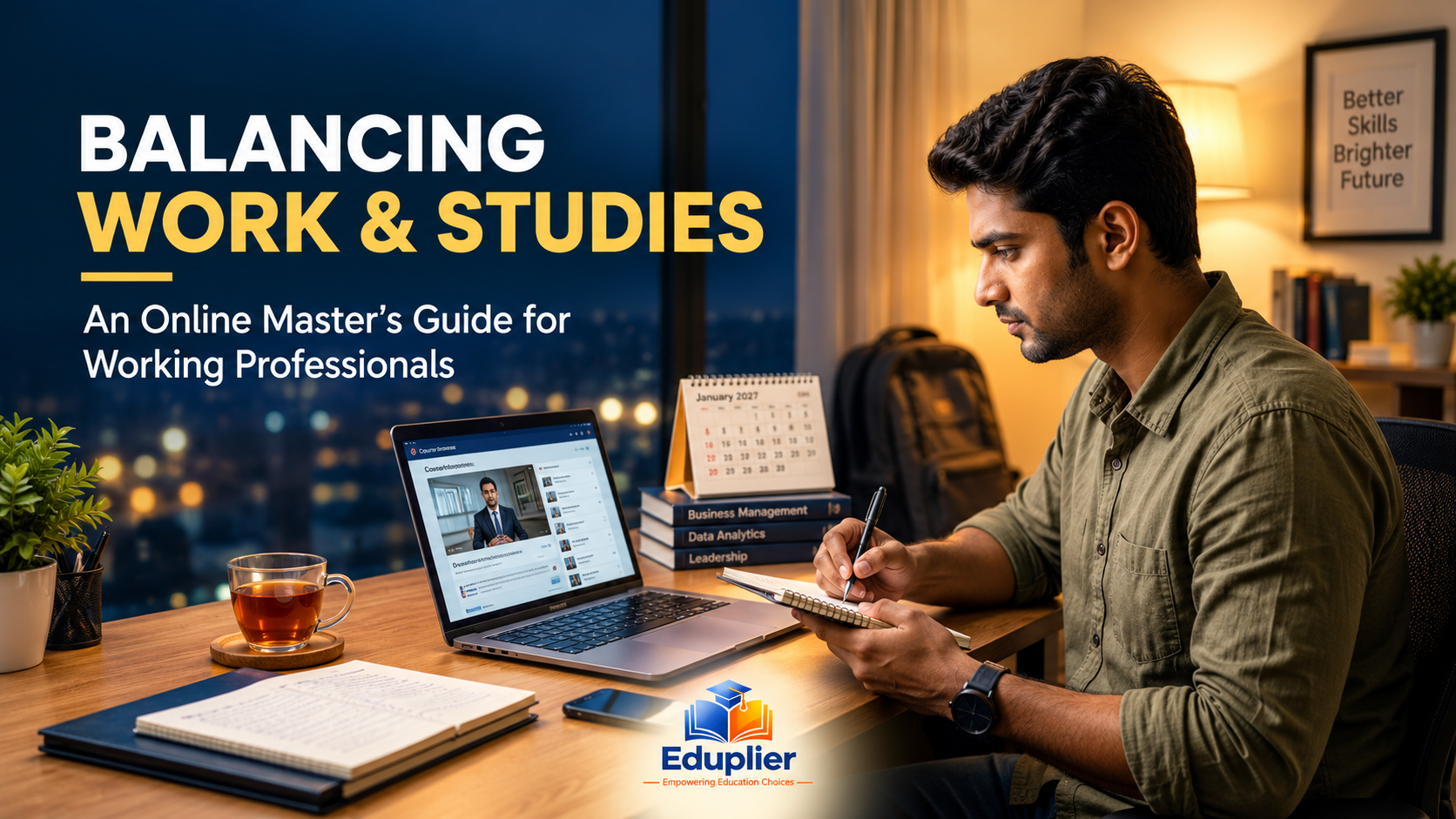
If you are thinking about an online degree today, it can be a very good choice. Upgrading your education is one of the best ways to grow your career. It can help you get promotions, move ahead in your job and increase your salary.
In the past, people believed that if you wanted to do a degree, you had to quit your job. Now there is a better way. An online degree lets you add a qualification and keep growing your career and income at the same time.
Can You Study Online While Working Full Time?
Yes. Thanks to UGC-entitled online master’s programs, such as an Online MBA, MCA or M.Com, you no longer have to choose between your paycheck and your degree. Here is a practical, step-by-step guide to help you balance work and an online master’s without burning out.
Consistency beats intensity. Short, planned study blocks, a university that suits working professionals, and proper rest matter more than long, exhausting study marathons.
1. Build a Realistic Weekly Study Routine
Online learning gives you flexibility, but complete freedom without structure often leads to procrastination. Instead of studying whenever you find free time, schedule fixed study blocks:
- Use the “Power Hour” method: Dedicate 45 to 60 minutes each weekday morning before work begins, or right after your workday ends.
- Capitalize on commute and breaks: If you commute by public transport or have an hour-long lunch break, use 20 minutes to read lecture notes or listen to recorded audio modules.
- Keep weekends focused, not exhausting: Dedicate 3 to 4 hours on Saturday and Sunday mornings for project submissions and recorded lectures, leaving your evenings free to relax and recharge.
2. Pick a University Built for Working Professionals
Not all online programs are structured the same way. The key to an easy balance is choosing a university that offers:
- Pre-recorded, on-demand lectures you can access 24/7.
- A mobile-friendly learning management system (LMS).
- Flexible weekend proctored exams.
- Dedicated academic mentors and student support desks.
3. Learn in Bite-Sized “Micro-Sessions”
Trying to sit down for a 5-hour marathon study session on a weeknight is a fast track to mental exhaustion. Break your syllabus into smaller tasks:
- Watch one 20-minute lecture at a time.
- Summarize one chapter using bullet points.
- Solve two practice questions every evening.
Consistent small steps throughout the week prevent last-minute exam panic.
4. Connect Your Coursework to Your Daily Job
One of the biggest advantages of working while studying is that your workplace becomes your practical laboratory.
- If you are pursuing an Online MBA, apply marketing frameworks, financial analysis or leadership case studies directly to your ongoing office projects.
- If you are enrolled in an Online MCA, use the coding assignments and cloud tools to improve real tasks at work.
When your coursework directly improves your on-the-job performance, studying stops feeling like extra homework and starts feeling like career preparation.
5. Prioritize Rest and Avoid the “Hustle” Trap
Burnout doesn’t happen because of hard work. It happens because of a lack of recovery.
- Get about 7 hours of consistent sleep.
- Take at least one evening completely off each week to disconnect from both screens and textbooks.
- Remember that consistency matters more than perfection. Even 30 minutes of focused effort every day will keep you on track.
6. Communicate Clearly with Family and Managers
Managing expectations around you is key to staying calm during busy semester weeks:
- At home: Let your family or roommates know your study schedule so they can give you quiet focus time during exam months.
- At work: You don’t need to discuss every assignment, but keeping your manager informed about your higher studies shows ambition. Many managers support upskilling and may offer flexibility during semester finals.
Need Help Picking the Right UGC-Entitled Program?
At Eduplier, we help you compare top online universities, understand fee structures, verify accreditations and choose the degree that fits your career goals and work schedule. Get free, unbiased admission guidance with Eduplier today →
Frequently Asked Questions (FAQs)
How many hours per week do I need to dedicate to an online master’s program?
Most working professionals need about 8 to 12 hours per week. A practical routine is spending 1 hour on weekdays for reading or lectures, plus 3 to 4 hours on Saturday or Sunday for assignments and review.
Is an online master’s degree valid for private and government jobs?
As per UGC regulations, online degrees earned from a UGC-DEB entitled university hold the same academic equivalence as conventional, on-campus degrees. They are widely accepted by private companies, public sector units and many government recruitments. Recruitment rules can differ, so always check the eligibility terms of the specific job and confirm the university’s current UGC-DEB entitlement.
Do I have to visit the campus for semester exams?
In most cases, no. Many online universities offer remotely proctored exams that you can take from home with a laptop, an active webcam and a stable internet connection, often scheduled over weekends to suit working schedules. Exam arrangements differ by university, so confirm them before you enrol.
Will my final degree certificate state the word “Online”?
UGC guidelines provide for online degrees to be equivalent to conventional degrees. Formats vary by university, but the certificate confers your program title, such as Master of Business Administration or Master of Computer Applications. Employers usually look at university accreditation and your real skills.
Can I get an education loan or EMI options for an online degree?
Many universities offer monthly EMI options and tie-ups with education financing partners, so you can pay semester-wise or month-by-month instead of one lump sum. Availability and terms vary by university and program, so ask for the current options.
What happens if I miss a live lecture due to office work?
Live sessions are usually recorded and uploaded to the university’s Learning Management System (LMS). You can log in whenever you are free and watch the full lecture at your own pace.
Need help choosing an online master’s program? Get free academic counselling
← Back to all articles