
Can I Prepare for UPSC While Doing an Online Degree? (Yes, Here’s How)
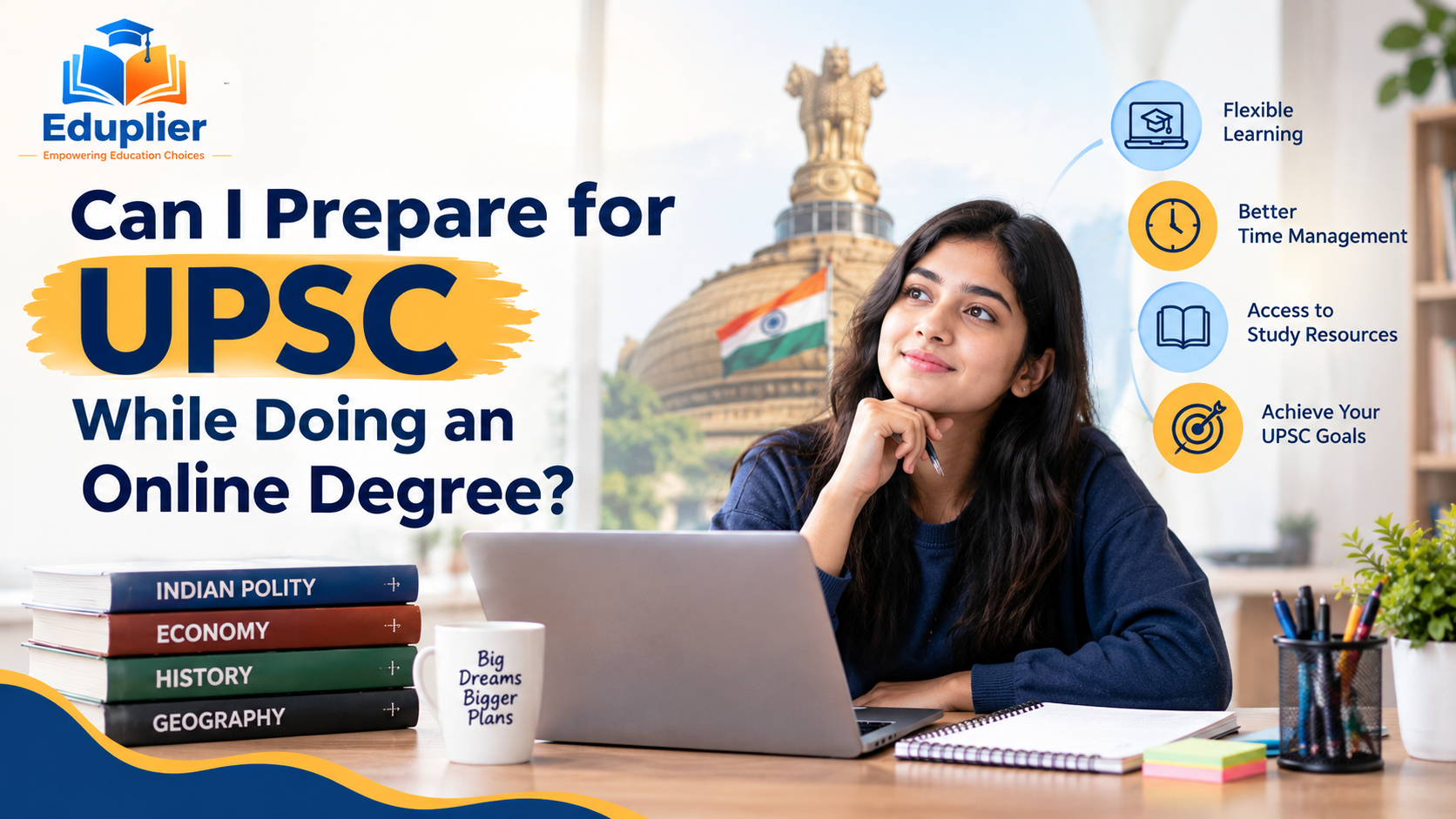
Preparing for the UPSC Civil Services Examination (CSE) is one of the most demanding academic paths in India. It takes between 1,500 and 2,000 hours of focused study. Candidates must read newspapers every day, practice writing answers, and revise consistently across diverse subjects.
For students who just passed their 12th grade or have recently started thinking about civil services, a big dilemma comes up:
"Should I go to a regular college and spend 6 to 8 hours a day in physical classrooms, or can I do an officially recognized online degree and dedicate the bulk of my time to UPSC preparation?"
The answer is yes. Many students now choose to pursue a recognized online degree while preparing full-time for UPSC. This path is not only legally valid, but it is also a highly strategic decision that is quickly becoming a preferred choice among modern aspirants.
This guide will walk you through the statutory rules, legal validity, syllabus overlap with the UPSC curriculum, balanced daily schedules, and common mistakes to avoid.
1. Is an Online Degree Legally Valid for UPSC Civil Services?
Before you invest your time and energy, you need to be completely sure about your eligibility so you don’t face any surprises later.
According to the official UPSC Civil Services Examination notification, a candidate must hold a graduate degree from a university that is:
- Incorporated by an Act of the Central or State Legislature in India, or
- Established by an Act of Parliament, or
- Declared as a "Deemed-to-be-University" under Section 3 of the UGC Act, 1956.
Under Regulation 22 of the UGC (Open and Distance Learning Programmes and Online Programmes) Regulations, degrees earned through online and distance modes from UGC-DEB recognized universities are considered completely equal to regular on-campus degrees.
This means that as long as your online degree comes from a university holding valid UGC-DEB (Distance Education Bureau) entitlement for that specific course, your degree is 100% valid for:
- Appearing in UPSC Prelims, Mains, and the Personality Test (Interview).
- State Public Service Commissions (UPPSC, BPSC, MPPSC, MPSC, etc.).
- Central government recruitment exams like SSC CGL, RBI Grade B, and CDS.
📖 Related Reading: Are Online Degrees Valid in India for Govt Jobs and Higher Studies? UGC Norms Explained →
2. Why UPSC Aspirants Prefer Online Degrees
A traditional regular college demands:
- Mandatory 75% attendance rules.
- Two to three hours lost every day in traffic and commuting.
- Rigid semester schedules that rarely align with the General Studies syllabus.
Pursuing an accredited online degree flips these disadvantages into strategic advantages:
| Traditional Regular College | UGC-Entitled Online Degree |
|---|---|
| Mandatory Attendance: 5–7 hours locked on campus daily. | Zero Commute & Flexible Hours: Study early morning or late night. |
| Fixed Timetables: Live lectures happen once at a set hour. | Recorded Classes: Replay lectures anytime on the university LMS. |
| High Daily Fatigue: Less than 3–4 hours left for UPSC preparation. | 6–8 Uninterrupted Hours: Dedicated daily study for GS, Optional, and Current Affairs. |
| High Relocation Expense: Hostel, travel, and lifestyle costs. | Affordable Tuition: 40%–60% lower fees, preserving budget for coaching and books. |
3. Which Online Degree Stream Should You Pick for UPSC?
The UPSC syllabus does not give preference to any specific degree stream. However, choosing a graduation course with significant syllabus overlap saves hundreds of hours of preparation:
1. Online Bachelor of Arts (B.A.) — Highest Synergies
- Key Subjects: Political Science, History, Public Administration, Economics, Sociology.
- The UPSC Advantage: Your university syllabus covers the core foundation of General Studies Paper I and Paper II (Mains) as well as Prelims GS Paper I. Furthermore, one of these subjects can directly double as your UPSC Optional Subject.
2. Online BBA / B.Com
- Key Subjects: Macroeconomics, Indian Financial System, Corporate Governance, Accountancy.
- The UPSC Advantage: Directly builds the conceptual base for GS Paper III (Economy, Budgeting, and Inclusive Growth).
3. Online BCA
- Key Subjects: Computer Applications, Logic, Programming, Database Management.
- The UPSC Advantage: Gives you a solid technical backup for the IT and corporate sector if you decide to explore alternative plans later, while making the CSAT (Prelims Paper II) analytical reasoning section feel second nature.
4. A Realistic Daily Timetable (Balancing Both)
Because online universities evaluate students through continuous online assignments and remote weekend exams rather than daily roll calls, you can structure your day like a full-time aspirant:
5. Potential Pitfalls and How to Avoid Them
While an online degree gives you an immense time advantage, beware of these common pitfalls:
- Isolation & Lack of Accountability: Without professors checking in daily, procrastination can creep in. Join a test series, study group, or local library to maintain competitive momentum.
- Ignoring University Semester Exams: You need at least a passing grade (preferably above 50–55%) to complete your graduation. Dedicate 10 to 14 days solely to college exam revision before every semester exam.
- Falling for Unaccredited Portals: Always verify that the university is listed under the official UGC-DEB approved list for the specific academic session. Don’t trust marketing claims blindly—verify the portal yourself.
Summary
Combining an accredited online degree with UPSC preparation is a practical and strategic approach. It eliminates commute fatigue, fulfills UPSC graduation criteria, and provides the dedicated 7 to 8 hours needed daily to master the vast Civil Services syllabus.
At Eduplier, our academic advisors guide aspirants to select UGC-DEB entitled online universities that match their target UPSC optional subjects, budget, and study timetables.
👉 Need guidance picking the right online degree for your civil services journey? Talk to an Eduplier counsellor for free today.
Frequently Asked Questions (FAQs)
Q1: Does UPSC ask about an "Online Degree" in the Interview (Personality Test)?
During the UPSC Interview, the board has access to your Detailed Application Form (DAF), which mentions your university and degree. The board respects candidates who utilized online education to manage their time efficiently, provided you can speak confidently about the subjects you studied. The focus is always on your clarity of thought, integrity, and analytical depth—not the physical delivery mode of your classroom.
Q2: Can final-year online degree students appear for UPSC Prelims?
Yes. Just like regular college students, candidates appearing in the final semester/year of their graduation degree are eligible to sit for the UPSC Civil Services Preliminary Examination. You must produce proof of passing your degree examination while filling out the DAF-I form for the Mains examination.
Q3: Will an online degree certificate say "Online" on it?
As per UGC regulations, the degree certificate clearly specifies the name of the degree program and the university. Some universities may indicate the mode of delivery (Online Mode) in compliance with UGC-DEB guidelines. However, by law, this does not reduce its equivalence or validity for any government examination or public service commission.
Q4: What if I decide to switch to a corporate backup plan later?
Top online universities feature dedicated placement assistance, virtual job drives, and corporate hiring partners. If you choose to take a break from civil services, your online degree holds weight for private corporate hiring, MBA admissions, or professional certifications.
Q5: Can I prepare for State PSC exams (like UPPSC, BPSC, RAS) with an online degree?
Yes. State Public Service Commissions adhere to the same UGC equivalence regulations as UPSC. Any degree recognized by the Central or State legislature qualifies you to sit for State Administrative Services.
Want to compare UGC-DEB approved B.A., BBA, or BCA universities for UPSC? Get free 1-on-1 academic counselling